The Stabi is your central library for humanities and social science research in Berlin: discover unique collections, thematic portals, and a diverse cultural program. We are happy to support you in workshops and provide guidance through our team of experts. Whether you prefer a focused working atmosphere in the reading rooms or collaborative work in dialogue with others: Our two buildings at Potsdamer Platz and Unter den Linden in the heart of Berlin are open to you every day from morning to evening. Come by and explore our services - we look forward to seeing you!
The opening and service times of individual areas can be found on a separate page.
At Stabi Unter den Linden, you will find literature related to the time period up to 1900, while at Potsdamer Straße, the collection focuses on topics from the modern era onwards. Our Special Collections are divided between the two locations.
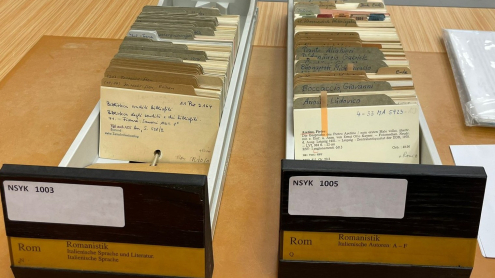
To access and order books at the Stabi, you will need a library card. For information on the location of specific books check the Stabikat. You’ll find introductory information in online-tutorials.
Only a very small part of the collection is accessible in the reading rooms. Most books are stored in the stacks and can be ordered online via the catalogue with a library card.
Generally, you can borrow books published in and after 1921. To do so, you need a library card and a place of residence in Germany. You can collect the volumes from the book pickup area at Potsdamer Straße.
The waiting time between ordering and delivery depends on the location of the requested book in the stacks. Check the status of your orders in your library account.
There is a cafeteria in both Stabi buildings . Unter den Linden also offers a canteen with an outdoor area and happy hour for students. Additionally, seating is available in the foyers of both buildings.
Die letzten Monate des Jahres sind in der Stabi immer auch die besonders veranstaltungsreichen! Informieren Sie sich in unserem aktuellen Programmheft und kommen Sie uns besuchen. Das Heft liegt in den Häusern Potsdamer Straße 33 und Unter den Linden 8 zum Mitnehmen aus. Wenn nicht anders angegeben, ist der Eintritt zu den Veranstaltungen frei. Programmheft […]
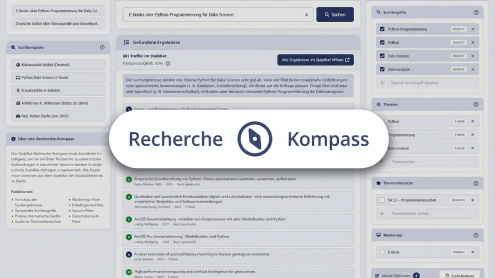
Mit über 200 Millionen Titeln bietet der StabiKat der Staatsbibliothek zu Berlin einen sehr großen Bestand an wissenschaftlicher Literatur. Für viele thematische Recherchen ist es hilfreich, neben klassischen Suchbegriffen auch bibliothekarische Schlagwörter, Systematiken und Filter für Sprachen oder Medientypen zu nutzen. Um diesen Rechercheprozess zu vereinfachen, steht ab sofort der StabiKat Recherche-Kompass in einer Beta-Version unter https://kompass.stabikat.de zur Verfügung. Das Werkzeug […]
Whether you need any tips on subject-specific research, on your PhD, or if you are new to the field of digital humanities, the Stabi team will provide competent and straightforward support – don’t hesitate to contact us!
Vor hundert Jahren, am 14. Juli 1926, kam Fred Rodrian in einer kleinen Hinterhofwohnung in Berlin-Friedrichshain zur Welt. Aus dem Jungen Alfred wurde später nicht nur ein Schriftsteller, sondern auch eine prägende Instanz des DDR-Kinderbuchmarktes: Als Lektor (1952–1955), langjähriger Cheflektor (1955–1974) und schließlich Direktor des Kinderbuchverlags Berlin (1975–1985) gestaltete er die Welt der DDR-Kinder- und Jugendliteratur in erheblichem Maße mit.
Eine Reise in die Welt arabischer Erzählungen mit der Arabistin, Übersetzerin und Musikerin Claudia Ott, dem Agrarökologen Marcel Robischon und Christoph Rauch, dem Leiter der Orientabteilung der Stabi.
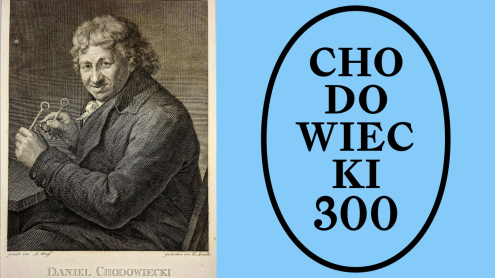
Zum 300. Geburtstag des berühmten Berliner Künstlers und Illustrators der Aufklärung, Daniel Chodowiecki (1726–1801), präsentiert die Abteilung Handschriften und Historische Drucke der Stabi besondere Schätze aus dem Nachlass- und Autographen-Referat, beispielsweise den Stammbaum Chodowieckis, sein Testament, Skizzen- und Tagebücher, Korrespondenzen und Urkunden, Exlibris und grafische Porträts.
Die Restauratorinnen der Staatsbibliothek öffnen zum Europäischen Tag der Restaurierung wieder für Besucher:innen ihre Türen. Werfen Sie bei einer unserer thematischen Führungen einen Blick hinter die Kulissen und erfahren Sie von den Expertinnen, mit welchen speziellen Techniken, Materialien und Methoden die wertvollen historischen Bestände der Bibliothek restauriert werden.
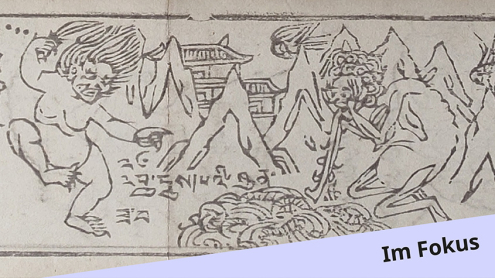
Die vorgestellten mongolischen und tibetischen Höllenfahrtstexte sind Zeugnisse religiöser Praxis und kulturellen Austauschs. Im Mittelpunkt stehen ihre materielle Beschaffenheit, Produktionstechniken und Sammlungsgeschichten.
Was geschieht mit einer Gesellschaft, wenn der freie Zugang zu Information unter Druck gerät? Der Schriftsteller Michal Hvorecký und die Journalistin Tamina Kutscher sprechen über Desinformation, Machtstrukturen und die Bedeutung von Literatur und Journalismus als Ort kritischer Wahrnehmung und gesellschaftlicher Verständigung.